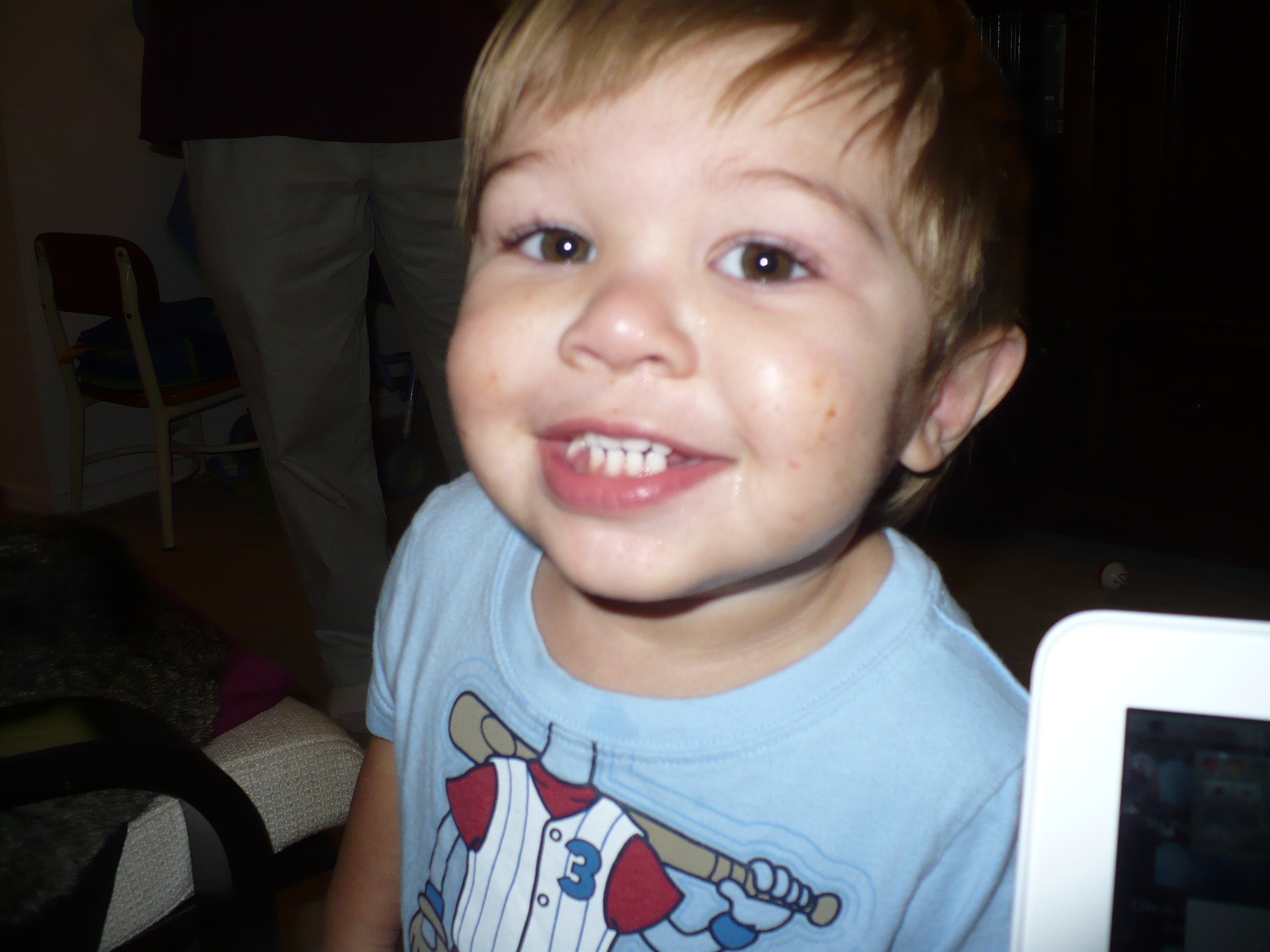
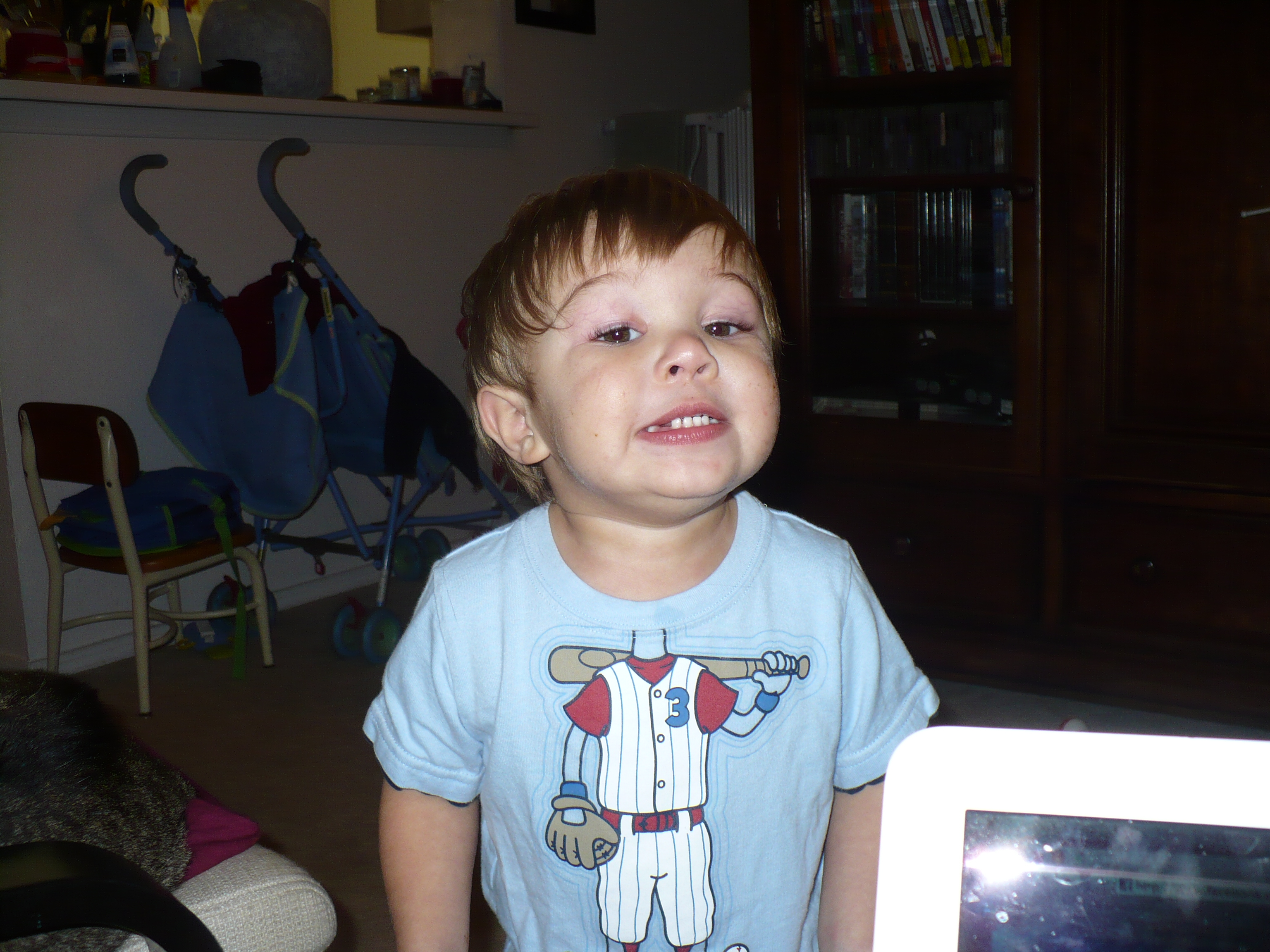
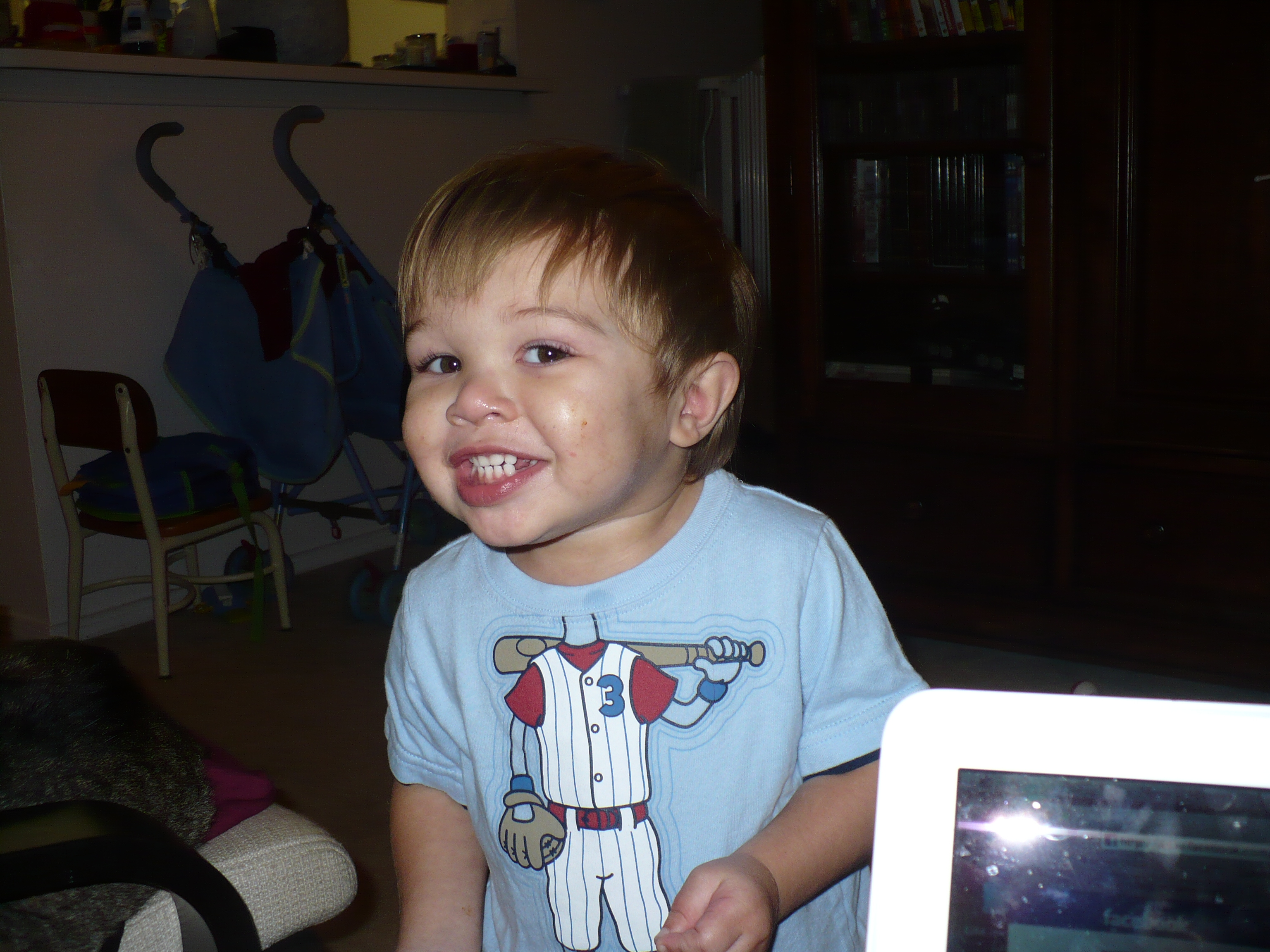
I’ve been trying to teach the Menininho to grin for the camera. I think he’s getting the hang of it, haha.

December 23, 2010
by marfmom
6 Comments
December 23, 2010
by marfmom
6 Comments
I’ve been trying to teach the Menininho to grin for the camera. I think he’s getting the hang of it, haha.
December 22, 2010
by marfmom
4 Comments
Awhile back I invited readers to submit their birth stories, to be posted while I take a maternity leave. Since Baby J is here, it’s time to post them! Some of the women have Marfan syndrome like me, but not all. If you have questions for the authors, feel free to leave them in the comments section; I’ll also try to email them any questions I see (as soon as I have time).
Ellen is a mother of three, a writer, and also has osteogenesis imperfecta. She blogs about reproductive choices from a religious perspective at Choices That Matter and is currently working on a book, to be published next year.
I knew early on that I wanted to have babies. There were significant obstacles to this desire (more of a calling, really), including my having a genetic bone disorder called osteogenesis imperfecta (OI). Any child of mine has a 50 percent chance of inheriting OI, which causes fragile bones, bone deformities, scoliosis, and other symptoms. I was terrified of the idea that a beloved child would have to endure frequent bone fractures, casts, surgeries, wheelchairs, braces, and pain, just as I did. But I was also certain that motherhood was something I was meant to do.
I was also fascinated early on with the mechanics of birth; in fact, for a time in my 20s, I considered becoming a midwife. I had a visceral desire to experience my own children’s births fully. I was not afraid of the pain involved; I had plenty of experience with pain. And it seemed to me that giving birth would be a way for my body to be redeemed, to be transformed from something fragile and incapable of so much (running, jumping, falling down without breaking) into something strong and capable.
My husband and I decided to have biological children in spite of my genetic risk. During one of my first ob-gyn visits with my first pregnancy in 1999, I brought up delivery options. My bone disorder is rare, and medical professionals who don’t quite understand it can be overly cautious. I knew from my research that women with my type of OI (the most mild type) who have not had pelvic fractures or pelvic deformities can deliver babies vaginally. I was also familiar with research indicating that c-sections are not necessarily safer for babies who have OI. But I was afraid my doctors would freak out about a fragile mom delivering a potentially fragile baby and insist on a c-section. I was relieved when the doctors said they were fine with my planning a vaginal birth. I settled into my pregnancy, took childbirth classes, and looked forward to seeing what my body could do.
But my baby had other plans. She was breech, and because of the potential for her to have fragile bones due to OI, the doctors were unwilling to try an external version (a decision I agreed with completely). I couldn’t believe, though, that I was going to end up having a c-section after all those years of looking forward to childbirth. I did everything I could to get her to turn—lay down with my hips elevated even though this made my heartburn much worse, pressed headphones with soothing music to my lower belly so the baby might try to move her head closer to the music. She didn’t budge. I reluctantly agreed to a planned c-section. Everything went well; my epidural went in painlessly and worked perfectly and the baby was healthy (she was eventually diagnosed with OI, but was born without any fractures). The doctor who delivered her said it was no wonder the baby didn’t turn; I am only 4-feet 8-inches tall, and my torso is very short. The doctor said it was a very tight squeeze and the baby just didn’t have room to turn herself around.
I found c-section recovery to be a breeze, perhaps because I’ve had lots of surgical experience. I was walking the baby around the block a week after her birth. But I had a lingering disappointment that I hadn’t gotten to prove myself by giving birth naturally. I made sure, when telling people that I had a c-section, to emphasize that it was because of the baby’s breech position, not because I was too fragile or weak to give birth.
With my second pregnancy, I decided to try a vaginal birth after cesarean (VBAC). I did a lot of research on my own. My husband is a medical librarian, so he brought home lots of journal articles discussing VBAC risks. I also consulted long-distance with an ob-gyn who has treated a number of women with OI, who agreed that my circumstances made VBAC a reasonable option. In my large ob-gyn practice, I saw a different doctor every visit. One older, more conservative doctor insisted I would never be able to give birth vaginally, because “short women have a hard time pushing.” When I asked a different doctor about this, he was flummoxed, because there is no correlation between a woman’s height and her ability to give birth.
I went into labor at dinnertime, about two weeks before my due date. When I arrived at the hospital, the doctor on-call was skeptical about my VBAC plan and had me sign a waiver essentially saying I understood all the risks and wouldn’t hold the hospital responsible if something went wrong. But the nurses were great and very supportive. I had a textbook labor, progressing steadily through the night. I had been undecided about what pain relief to request, if any, and eventually asked for an epidural when I was about 5 centimeters dilated. Getting the epidural was a hair-raising experience. I was having contractions every two to three minutes, and the anesthesiologist had trouble getting the needle in the right spot. She finally got it in, but it was in a blood vessel, so she had to start all over again. Finally, once the epidural was in and working, the anesthesiologist admitted she was nervous about poking a needle into a fragile spine. I could have told her that an epidural needle was not going to break my back.
I settled in to get some sleep, but soon my water broke and I started feeling a lot of pressure. A resident came to check my progress, and asked the nurse for an ultrasound machine, because, “I don’t know quite what I’m feeling.” Turns out she was feeling my baby’s bottom. This baby too was breech, but for some inexplicable reason, my doctor had not checked the baby’s position when I was admitted. The resident said to me, “You know what this means, don’t you?” To which I answered, “Yup. I sure do.” Another c-section. Honestly, at that moment, I was not bothered by this turn of events. Knowing now that the baby was breech and that I was in transition, I was anxious to have the c-section because I had no interest in a vaginal breech delivery. Our second daughter was pulled from me about an hour later. I was disappointed that things turned out as they did, but still glad that I got a chance to go into labor spontaneously and know what active labor feels like.
Two years later, I had our third and last baby, a son. While this baby finally got the head-down position right, there was no possibility of my having a vaginal birth. After two c-sections, my doctors would not agree to a VBAC, and that was fine by me. By that time, I understood that childbearing had redeemed my broken body, even if I hadn’t experienced natural childbirth. My body carried and nurtured three new human beings. That they were cut out of me rather than pushed out just doesn’t matter.
I’ve realized one thing that can make women who’ve had c-sections feel that we’ve missed out on something vital. We mothers love birth stories. Even now, when I and most of my friends are done with having babies, we still sometimes share stories about those days and nights that changed everything.
C-sections don’t make very good stories. We are passive recipients of medical attention. We can’t make our girlfriends guffaw with recognition when we talk about how we told the doctor to go %&^*# himself when he told us to push harder. We can’t relate with pride that we sent away those pesky medical practitioners who wanted to try pitocin, because we were doing just fine on our own, thank you very much. We can’t talk about how long we pushed, or rings of fire, or the way our heart sped up with excitement and terror when told we were at the magical 10 centimeters. I think birth stories in part are a way for women to remember this transforming experience, to feel pride and awe at what their body did, to remind themselves and others that, while they may be wearing stretch pants and milky sweatshirts, they just accomplished something amazing. C-section stories don’t offer any of that. Add to that all the voices telling women that c-sections are not the ideal birth, and it becomes difficult to talk about at all, much less with pride.
During my third c-section, my epidural didn’t work completely. So I had to use all of those breathing techniques I’d never needed before, and I had a pretty darn good story (if a pretty awful experience). It was the first time I felt like I had something interesting to tell my friends about my baby’s birth, and the first time people were really interested in hearing all the details.
I still read birth stories sometimes, even though my childbearing days are over. I share with home-birth and natural-birth advocates a frustration with overmedicalized birth and too-frequent inductions and c-sections. But I’m also impatient with those who, in advocating for less medical intervention in birth, claim that women can “trust their bodies.” Don’t they know, I wonder, that bodies are not really worthy of one’s trust?
Theologian Hans Reinders describes people without any obvious illness or disability as being “temporarily able-bodied.” There is such truth in that. All bodies break, all bodies fail. The power of childbearing does not lie in our bodies’ ability to do exactly what we want and expect them to. My body has never done exactly what I wanted and expected it to, especially when it came time to birth my babies. The power of childbearing, rather, lies in our bodies’ ability to bring forth something exquisite, miraculous, and imperfect (as all human beings are) from its own exquisite, miraculous, and imperfect depths.
December 21, 2010
by marfmom
4 Comments
Awhile back I invited readers to submit their birth stories, to be posted while I take a maternity leave. Since Baby J is here, it’s time to post them! Some of the women have Marfan syndrome like me, but not all. If you have questions for the authors, feel free to leave them in the comments section; I’ll also try to email them any questions I see (as soon as I have time).
Bio: Heather has a connective tissue disorder (not Marfan syndrome), ankylosing spondylitis, spinal stenosis and pituitary dwarfism. She is a birth advocate and chose to have an unassisted home birth after a previous c-section (UBAC). Heather blogs at Babyslime.
Birth has always been a pretty charged topic for me because it was one of those things I was told I “couldn’t do” for any number of reasons. I’m tiny with a malformed pelvis and very short torso from an uneven result of treatment for pituitary dwarfism, I suffer with hypermobility syndrome and arthritis, as well as ankylosing spondylitis with some spinal fusion and stenosis as a result. These problems cause a lot of pain and mobility problems, and require daily medication to maintain a livable quality of life.
I’m very petite (5′), and my partner is very tall (6’4″), so on top of all the physical problems that apparently prevented me from having an “average” baby, it became a fun joke to tell me all about how our ‘average’ would be a huge 9lber that had no hope of being born naturally.
My first birth was natural and attended by a midwife, but very long and very difficult. My daughter ended up being quite petite (6lbs, 14oz) and I was reminded again at how lucky I was that she was so little… it took me 44 hours to get her out, “just imagine if she’d been larger!”. It made me angry because I know that isn’t true: even a big fat baby isn’t going to somehow grow a larger skull… and fat squishes! I hated having to fight against the idea that women “like me” were only capable of having surgical births.
My second pregnancy and birth resulted in an unwarranted, and forced, cesarean followed by the death of our first son (which was caused by a birth defect, and was unrelated to his birth). When I became pregnant again a mere 6 weeks later I was pretty scared that history was going to repeat itself. I chose to take on the commitment of a self-care pregnancy and birth after intense research, and realizing that the best way to get a healthy birth for my baby and I was to go it alone. I knew the VBAC bans and rules about rupture rates were not as much based in fact as they were based on politics and fear of litigation, and even though many of the local midwives knew that, their hands were tied: either I’d be scheduled for a repeat cesarean and take on the heavy risks associated with it, or I did what I could to ensure the healthiest outcome and started working hard to educate and prepare myself (and my partner).
Though I do want to be clear that I don’t advocate unassisted childbirth for anyone else: it’s a pretty big commitment, a very important decision and never to be taken lightly.
My commitment to our safety paid off, and I went on to have a VBAC “UC” birth in my bathtub to my 9.5lb baby boy at 3 weeks past my due date. Here’s the story of his birth on October 3rd, 2006.
Around 5am I woke up to a few mild cramps. The anticipation more than the sensation kept me awake until my husband woke up two hours later to leave for work. They weren’t regular and were pretty mild. Every half hour or so I’d have one that hurt, but then they’d stop for long periods of time. I let my husband know what was happening, but told him to go to work anyway; if they actually turned into something I’d call him in a few hours.
After he left I got up and plodded around the house a little bit, and the more I moved the more they spread out and eventually just felt like mild gas pains. I ate some breakfast, talked with my friend LC who was staying at the house with her seven month old girl, and by 9:30am I was much too tired to stay awake any longer. I asked LC if she would watch my three year old, Tempest, for me and went back to bed for a nap.
I slept soundly for three hours, and when I woke up I felt a hundred percent better. Plus, the on-and-off cramps had stopped completely: I wasn’t even awakened once. I frequently got these kinds of cramps throughout my pregnancy, although usually only in the evening, so I dismissed them as a return of my irritable uterus.
Earlier that day I had written to a few close friends that I thought the cramps might turn into something and now I felt silly for jumping the gun; I was on my way to change my message to “false alarm” and made a quick stop at the bathroom first. When I undressed I saw that I’d lost my mucous plug in a very big (and gross) way. I checked my cervix; it was around 4cm dilated with a bulging bag. I’ve never had a bulging bag before so I had no idea what it was at first. The baby was still facing outward at this point so I gave into the fact that I’d be having my third posterior labour! I guess when you don’t know the difference it’s not that bad.
Since I had made it up to 5cm before I ever even started labour with my second child, I didn’t count this so quickly as being “in labour”, but I did figure that it would be within the next few days. I still wasn’t getting any contractions.
LC and I decided to go for a walk down to the corner store for some drinks. I’m pretty sure she offered the walk to try and perk my contractions back up again, she had that look in her eye when she grabbed her coat.
We were gone about half an hour and while I walked I started feeling a few tiny squeezes every few minutes, but they really weren’t that regular nor painful. I only had to stop walking twice, and not so much for pain as much for the intensity of the squeeze; they felt a little like someone taking both hands to the side of my belly and pushing it inward. These felt different from my day-to-day cramping but also didn’t feel quite like real labour – I wasn’t convinced!
When I came home and sat down they spaced out to ten-to-fourteen minutes and I barely felt them, but I had already resolved to call my friend Amber (who would be photographing) and my husband just the same. Even if it wasn’t labour I figured my husband wouldn’t mind coming home an hour early. I predicted that real labour would probably hit late that night or the following morning since all of this warm-up generally happens a day or so before the real contractions start going.
I left a message for my friend and then called my husband and told him to come home. When he repeated, “Now?” back into the phone I heard co-workers behind him start cheering and clapping. While I waited for him to arrive I tried to check myself again, but couldn’t find my cervix. The bulging bag and now part of a head were so low that I couldn’t get my fingers in far enough to feel what was going on. I figured I couldn’t be that much further in after only 45 minutes and gave up on that. Real labour hadn’t actually started yet, and the only difference seemed to be that the baby had engaged. The squeezes were sometimes as far as twenty minutes apart and I barely noticed them anyway.
I sat on a birthing ball in front of the computer and made some updates, chatted with friends and checked my forums. my husband came home about ten minutes later, and literally as soon as the front door opened real labour hit and the contractions were suddenly five minutes apart and intense. It was as though someone had flicked a switch to start me up!
Suddenly I couldn’t get off the ball; every time I tried to stand up, a contraction would hit and I’d have to sit back down again. I ended up stuck at the computer like this for over an hour. I was feeling rather ridiculous, thinking that if I was going to have my baby in front of the computer with forums and friends up on the screen I could never again claim to not be addicted to the internet.
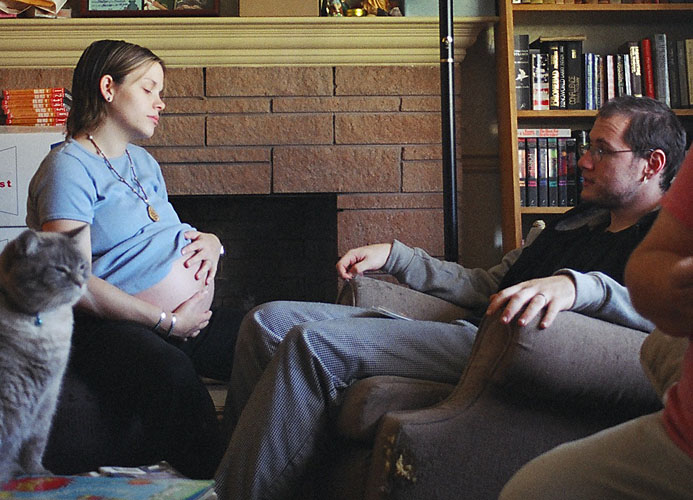
Finally I managed to get up and go to the bathroom. I wanted to be alone for a while and feel my contractions without distraction. I laboured on the toilet for another hour, alone. The contractions so felt much easier there: I was able to focus more on opening up and made quieter, lower noises through them. I kept my fingers and throat open and tried to make my body limp as each contraction crept up. It was working very well, being alone and not afraid that eventually someone would burst in made it so much easier to relax. I was almost able to sleep, or at least disassociate, through the contractions by self-hypnosis. After a while I stopped needing to make noise, and just sat and breathed. It was wonderful!
I continued this for about forty minutes before the cramps became intense enough and I was unable to continue the meditation through them. I had a little bit of bloody show at that point, and was still unable to check myself because of how low the baby’s head was.
My husband knocked and quietly asked permission to enter my “birthing zone” to bring me ice water with a bendy straw, as well as some yogurt and granola. I ate as much as I could, but was starting to feel nauseated and couldn’t finish . After a few more contractions I decided to try and fill up the tub and see if some of the warm water would help.
I ran the bath as high as it would go and got in. It was at this point that I started feeling that intense “nothing is working” feeling that is very typical of transition, although I didn’t recognize this as transition (also typical of transition…). The contractions were a little closer together, and a little more intense but I was still waiting for them to get “really bad” and still considered myself in early labour.
At the tail end of a few contractions I felt this very odd tingling feeling in my chest and upper belly. It was something I’ve never experienced before. It felt almost like a tiny urge to push, more of a nudge than an urge. With the next contraction I tried giving a little push and that felt pretty good, so I called my husband in and asked him to stay. I still didn’t feel like I was really that close to the end, so I imagined I would be hitting transition soon and I wanted him there to support me through that. I always expect transition to be so dramatic that I cannot possibly mistake it for anything else, but this is my third labour now and I have yet to be “taken over” by one the way I hear of others experiencing it.
The tickling feeling started to get a little more nagging, but still didn’t feel like a real urge to push. I held it in, not exactly scared but definitely unnerved by the speed, and the idea of letting go of this baby. The last baby who left my body died shortly after birth, only 11 months prior, and I was struggling throughout pregnancy with the fears that leaving the safety of my womb and cutting the cord would result in the death of my child.
I asked my husband to give me some reassurance that it was okay to give in and start pushing, and as soon as the words left his mouth my water broke with a huge pop that was audible even underwater. The level of the tub raised up by about an inch, if not more. There was some meconium (normal for postdates babies) and a little bit of blood in the water. I knew immediately that it was really close. I felt his head come down very hard and the urge to push was now undeniable. I leaned back in the tub so I could raise my hips and get as much coverage in the water as possible. After only one big push I started to feel a burning sensation, so I had my husband reach down and feel his head just as it started to crown. I could feel the thick rolls and wrinkles on the top of his head and realized he was going to be fat, just like I’d been hoping.
The next few minutes were so incredibly intense for me. Not just physically, but emotionally. It was coming very fast and I had expected myself to be terrified of letting go of this baby… but I wasn’t.
I applied very gentle counterpressure to my perineum to prevent tearing when I felt him crown at his biggest, and my husband mistakenly thought I was trying to push him back in and at first tried to gently move my hand. It’s a little difficult to speak coherently when one is crowning a baby, so all I could muster was, “No no no!”. I’m not a big fan of the ring of fire sensation, so I made a lot of horrible noises over the few seconds it took for his head to come out.
Once his head come out all the way the relief was instant. I reached down and felt his nose and eyes. He came out anterior, even though when I’d checked his positioning a few hours ago he was still firmly set in a posterior presentation. I had felt a lot of spinning and moving just moments before I started pushing and I imagine that’s when he turned the right way.
I felt him rotate his body to prepare his shoulders for birth; the feeling was just like someone trying to pull him out and I yelled, “What the hell is that?!” so loud that my friend and mother sitting in the livingroom could hear me! My husband didn’t have an answer for me and didn’t realize I was asking rhetorically. It was an incredibly weird feeling.
About twenty or thirty seconds passed and I gave one more push. His body flew out so fast he went clear across the tub. Both my husband and I reached down and together we pulled him up out of the water and onto my chest. He was a little gray at first so I started vigorously rubbing his back. I turned him over one arm and slanted him downward, saying, “Come on baby, come on baby”. My husband tells me later this made him nervous, but I wasn’t afraid at all. I knew he was fine, but my husband admits this was the point where he forgot everything I’d ever told him about how being a bit slow to start is okay when you’re not clamping cutting the cord the instant they’re out. The umbilical cord continues to provide a steady stream of oxygen, blood and nourishment until the placenta detaches from the uterine wall: it is a lifeline.
I saw him open up his eyes right away, he started grunting a few seconds later, and pinked up very fast after that.
My mother, LC and Tempest were waiting outside the door and all came in to see him just as we were lifting him out. I vaguely recall my mother asking, “She’s okay?” when she saw his (we were all thinking “her”) colour right at birth.
“Yup!”, I answered. I asked LC to check her watch and it was 6:10pm, and it had been about two minutes since he’d emerged so we called it 6:08!
Tempest wanted to join me in the tub, but it was pretty gross so I asked her not to get in. Instead she perched on the edge: “That’s a baby! Look at that baby! That baby came out your ‘gina. That baby is sad. Will you nurse that baby with your nipple?”.
The baby started nuzzling at my breast but didn’t seem too interested in nursing. A few minutes later my mother asked, “What’s her name?”
“He. It’s a boy,” said my husband.
“It is not,” I said. I lifted his legs to check, and then started screaming! I was so happy it was a boy. My husband had noticed as soon as he came out but kept it so that I would figure it out on my own.
Less than five minutes after he was born my husband pointed out that the placenta was sitting right at my perineum, so I gave a tiny push and it came right out. We stayed in the tub about twenty minutes adoring our new baby before I pulled the plug and had my husband set up the bed with chux pads so I could lay down. I wrapped our new son, Xan, in a towel that my mother had just warmed in the dryer and passed him to LC so that I could clean off the placenta in the tub and check it over to make sure it was whole.
As I rinsed myself off I noticed quite a few large clots so I asked my husband to bring me a half cup of water with a few teaspoons of chlorophyll in it to help rebuild blood supply. I drank a glass of ice water, and then sipped on some orange juice as I got into bed and nursed him. Amber arrived about ten or so minutes later (missing the three hour birth completely!) and started taking photos.
In the meantime, I called my father and announced the news personally, my husband called his work (that he’d only left a few hours before!) and his mother.
I felt so comfortable and glowing. I wasn’t even the slightest bit sore. Everything just seemed absolutely perfect and… normal. Even though something so amazing had just happened, I could just get up and go on with life. I didn’t even think about my cesarean scar, or my hospital experience less than a year before.
After a few hours I called my LLL Leader and asked to borrow her scale to weigh him since we had forgotten to pick one up. She came by, oohing and awwing, took part in the weighing and asked me all about my birth. I promised to come and show him off at the next meeting (eight days later) and gave her permission to make a birth announcement to the email list.
Amber went and picked up my friend Marian who had been present at my daughter’s birth and brought her over to see him. I was up until almost 2am, nursing, making phone calls and letting it sink in that I’d just given birth. Life felt so undisturbed by the process; it was so quiet.
It’s amazing to have a secret no one else knows until you choose to tell them.
A baby was just born and the only people who know of his new existence were those I wanted to. We had the opportunity to tell whoever we wanted, whenever we wanted.
Xan Ronan was 9.5lbs 21 inches long and about three weeks overdue!
As a tiny woman living with disability and the idea that I’d never be able to birth an average baby (let alone a large one) it’s pretty nice to be able to hold up my big fat newborn and say that not only did I birth over nine pounds of bouncing baby boy naturally and unassisted, but I did it VBAC!
